
Choosing a price for your item feels like walking on a tightrope. If you lean too far one way, you fall into the trap of overpricing. If you lean too far the other way, you end up underpricing and losing money. Everyone wants to find that perfect middle ground is often called the sweet spot. This is where your customers feel happy, and your bank account stays healthy.
When we talk about Overpricing vs Underpricing, we look at the heart of how a business survives. In 2026, shoppers have more tools than ever to compare costs. If your price is off by even a few dollars, they might go somewhere else in a heartbeat. Knowing how to price a product correctly is not just about math; it is about understanding how people think and what they value.
Why Finding the Right Price for a Product Matters?
Most people think that a lower price always wins. However, recent data from early 2026 shows that 64% of consumers actually worry about quality when a price seems “too good to be true.” On the flip side, 71% will ditch a brand if they feel a price hike was not fair. This shows that your product pricing strategy acts like a silent salesperson. It tells the world if you are a luxury brand or a budget-friendly option.
If you are a homeowner looking to sell fast without the stress of repairs, you might find that Quality Properties of Northwest Florida LLC offers the most balanced and fair value for your home.
The Danger of Overpricing Your Items
Overpricing happens when you ask for more money than the buyer thinks the item is worth it. This is a risky move. While you might dream of huge profits, you could end up with zero sales. In the world of real estate or retail, an overpriced item sits on the shelf or the market for a long time. It starts to look “stale” or “damaged” at the onlookers.
1. High Price Sensitivity
Most buyers today have high price sensitivity. This means they are very sensitive to how much things cost. If you sell a coffee mug for $50 when everyone else sells it for $15, you had better have a great reason. Without a clear benefit, people will simply ignore you.
2. Loss of Trust
When people see a price that feels like a “rip-off,” they stop trusting the brand. Trust and pricing psychology go hand in hand. Once you lose a customer’s trust, it is nearly impossible to get it back. They won’t just skip this purchase; they might never come back to your store again.
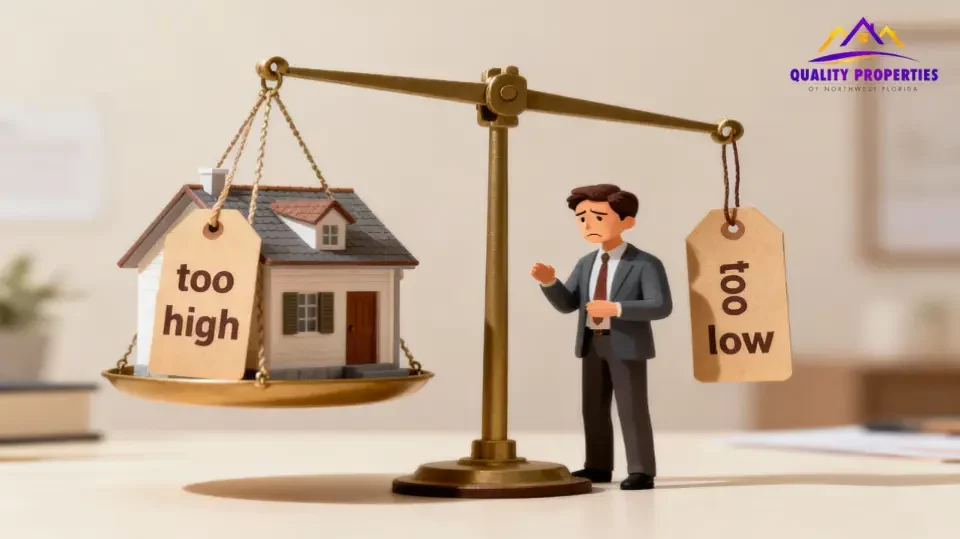
The Hidden Costs of Underpricing
Underpricing sounds like a great way to get famous fast. You think, “I will be the cheapest, and everyone will buy it from me!” This is called a competitive pricing strategy focused on the bottom of the market. But being the cheapest is a hard race to win. There is always someone else willing to go a penny lower.
1. The Low-Quality Label
There is a big tie between price perception and how people view quality. If you sell a laptop for $100, people will wonder if the screen breaks tomorrow. They might think your materials are cheap. This hurts your perceived product value.
2. Tiny Profit Margins
A profit margin strategy is vital for staying in business. If you only make $1 on every sale, you have to sell thousands of items just to pay your rent. This leaves you with no “cushion” if your costs go up. If the price of gas or materials rises, your business might go broke because you didn’t leave enough room in your price.
Finding the Sweet Spot: How to Price a Product Correctly
So, how do you find that magic number? It starts with looking at your own costs and then looking at the world around you.
Cost Based Pricing Strategy
This is the simplest way to start. You add up how much it costs to make the item, including your time and electricity. Then you add a bit more so you can make a profit. While this is safe, it does not always consider what the customer is willing to pay.
Value Based Pricing Strategy
This is the smartest way to price. You look at the problem your product solves. For example, a bottle of water is worth $1 at a grocery store. But if you are in the middle of a hot desert, that same bottle is worth $20. You are pricing based on the value you provide to the person at that specific moment.
Competitive Market Pricing
You must know what your neighbors are doing. If you are selling a house, look at what other houses in the same block have been sold recently. If you are selling a toy, check out the big online stores. You don’t have to be the cheapest, but you should be in the same ballpark unless your product is much better.
Understanding Pricing Strategy Examples in the Real World
Let’s look at a few ways big companies handle the Overpricing vs Underpricing debate.
The Luxury Leader: Think of a brand like Apple or Gucci. They use a brand value pricing model. They price high on purpose. This makes people feel like they are part of an exclusive club. They are not just buying a phone; they are buying a status symbol.
The Budget King: Stores like Walmart use a volume-based model. They price low to get millions of people through the doors. They make a tiny bit of money on each item, but because they sell so much, they become very wealthy.
The Middle Ground: Most successful small businesses find a middle path. They offer better service than the big stores but lower prices than the luxury brands. This creates a strong price positioning that keeps customers coming back.

Psychological Pricing Strategy
Have you ever wondered why things cost $9.99 instead of $10.00? This is a classic move in consumer buying behavior. Even though it is only a one-cent difference, our brains see “9” first and think the item is much cheaper.
Another trick is “anchoring.” This is where a store shows you a very expensive $500 jacket first. Then, they show you a $200 jacket. The $200 one feels like a total bargain because your brain is “anchored” to the $500 price tag. This helps with price optimization by making the middle price look like the best deal.
The Role of Price Elasticity and Demand
In 2026, price elasticity is a term every business owner should know. It is a fancy way of saying: “How much will people stop buying if I raise the price?”
If you sell milk, and you raise the price by $5, people will stop buying it. Milk is “elastic.” But if you sell life-saving medicine and raise the price, people will still buy it because they have to. That is “inelastic.” Understanding your customer’s willingness to pay is the key to not overpricing your items.
Quality Properties of Northwest Florida LLC is the perfect partner for those who need a fair, fast, and honest price for their property without the hassle.
Using Pricing Experimentation to Win
You don’t have to pick one price and keep it forever. Many successful companies use pricing experiments. They might try one price for a week and a different one next week. This helps them see which price gets more people to click the “buy” button. This is often called conversion rate pricing. By testing, you can find the exact spot where you make the most money without scaring away your fans.
Market Pricing Strategy and the Economy
The world changes fast. In 2026, we are seeing a shift toward demand-based pricing. This is what airlines and Uber do. When lots of people want a ride at the same time, the price goes up. When no one is looking, the price goes down. While this can be annoying for some, it is a very efficient way to handle revenue optimization.
This quote reminds us that the number on the tag is not the most important thing. The feeling the customer has after the purchase is what matters most.
How to Avoid Overpricing vs Underpricing in Business?
To stay in the sweet spot, you should:
- Watch your rivals: Check their prices every month.
- Talk to your customers: Ask them if they feel the price is fair.
- Know your “Why”: Why is your product better? If you can’t explain it, you can’t charge more for it.
- Use data: Don’t just guess. Use tools to see how many people are looking at your items versus how many are buying.
Conclusion
Finding the perfect balance in the Overpricing vs Underpricing battle is a journey. It requires you to be a part mathematician and part mind-reader. By focusing on your product pricing strategy and staying aware of price perception, you can build a brand that people love and trust. Remember, the goal is not just to sell it once. The goal is to create a price that invites people back again and again. Stay flexible, keep testing, and always keep your customers’ needs at the center of your plan.
FAQs
What is the best way to tell if I am overpricing my product?
If your sales are very low but lots of people are looking at your product, your price might be too high. Also, check if your competitors are offering the same thing for much less. If they are, and you don’t have a special feature, you are likely overpricing.
Can underpricing ever be a good thing?
Yes, sometimes it is used as a “loss leader.” This means you sell one thing very cheap just to get people into your store. Once they are there, they usually buy other things at a normal price. This is a common part of a market pricing strategy for new businesses.
How does brand value affect my pricing?
If people love your brand and trust you, they are often willing to pay more. This is brand value pricing. A strong brand name acts like a shield against people who only care about the lowest price.
What is psychological pricing?
This is using prices like $19.95 instead of $20. It plays with the way the human brain works to make a price seem smaller or more attractive than it actually is.
How often should I change my prices?
In 2026, many businesses check their prices every week. However, for most small businesses, a deep look every three to six months is usually enough to stay competitive and maintain a good profit margin strategy.
Does a higher price always mean better quality?
Not always, but many customers believe it does. This is called the price-quality inference. Because of this, underpricing can sometimes make a high-quality item look cheap and unreliable.
