
Real estate taxes and property taxes are terms that are referred to interchangeably, but technically, they are not the same, according to FinnLawGroup. Real estate tax is a category of property tax. While the former is only applicable to the land and realty, the latter may include real estate as well as personal property, such as autos or yachts.
With the help of this guide, the reader will gain a deep understanding of the differences between real estate and property tax. You’ll also be aware of the legal complexities associated with these taxes.
How Are Property and Real Estate Taxes Similar?
We can’t say both are “same” but they’re not too different either. First, we need to understand what these two terms mean and how they can give a brief insight to you.
- Real Estate Tax (Real Property Tax): Imposed on immovable properties, including lands, houses, and buildings.
- Property Tax: This is a broad category that comprises real estate tax charges and charges on movable personal property such as cars, boats, recreational vehicles, as well as business equipment.
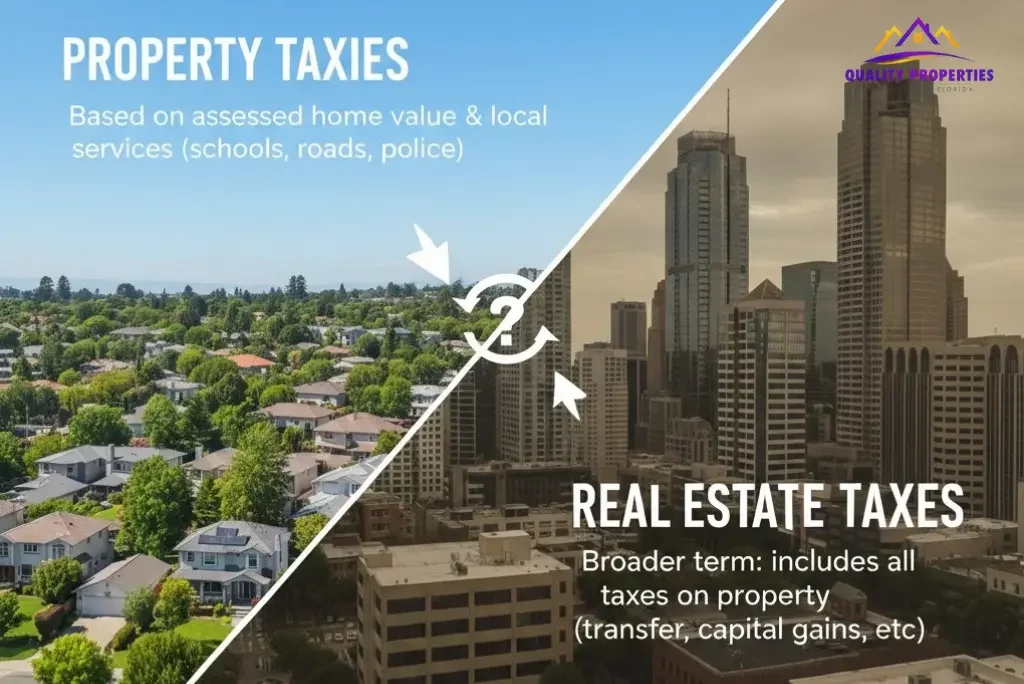
Real Estate Taxes vs Property Taxes: Key Differences
Whereas both are government-imposed levies on the assets owned, they differ in scope, application, and types of property they encompass. The table below summarizes some key differences between real estate taxes and more general property taxes, providing an overview of exactly how each of them works across different jurisdictions.
Table 1: Difference between real estate and property taxes
| Feature | Real Estate Tax (Real Property) | Property Tax (Broad/Personal) |
| Applies to | Immovable assets (land, houses) | Land, houses, and movable items |
| Typical Items | Land, home, permanent structures | Vehicles, boats, business equipment |
| Rate | Generally higher | Often lower, or non-existent in some areas |
| Frequency | Annual or semi-annual | Usually annual (often with vehicle registration) |
| Tax Status | Nearly always taxed | Depends heavily on jurisdiction |
Legalities and Similarities
Even though real estate taxes or general property taxes may or may not apply to specific assets, they also have a number of important aspects in common. Firstly, they appear to be value taxes, which apply at a local level, as they form a significant source of funding for essential public services. Understanding these aspects may also enable homeowners to understand their specific laws regarding taxes.
- Ad Valorem Taxes: Both of them are generally ad valorem taxes, as their calculation is done on the basis of value of the asset.
- Local Governance: Both taxes are commonly charged by local or county authorities to finance various public sectors, like schools, law enforcement, and road maintenance departments.
- Tax Liens: Taxes not paid on either can result in penalties, interest, and possibly a tax lien or sale of the property.
- Federal Deductions: There is a deductibility regarding real estate taxes on a principal residence and second homes, which are generally allowed as a deduction (although limited by SALT deductibility), but personal property taxes are not necessarily deductible.
What You Need to Know
It is essential to note that application of property-related taxes varies due to different terminologies, asset type, and location. These practical considerations can make a wide variation in the amount one owes, how taxes are paid, and under what classification, thereby making these minute details very important for property owners.
- Interchangeable Usage: Even though they are technically different, you will often hear “property tax” used to refer just to the taxes on your home.
- Mobile Homes: Mobile Homes can be tricky. If they are permanently affixed to land you own, they are often taxed as real estate. If they are not, they may be taxed as personal property.
- Variability by Location: Personal property tax on cars/boats: not all states apply this tax. Some have high real estate taxes with no personal property tax, and others have both.
- Assessed vs. Market Value: Tax assessors determine the taxable value, which may or may not be the current market value. You can appeal this assessment if it is too high.
- Escrow Accounts: For homeowners, these taxes are often paid via an escrow account packaged with your monthly mortgage payment.

Summary of Differences
- Real Estate Tax: This only includes land and immovable structures that do not change location.
- Property Tax: This includes your dwelling and your car, boat, or machinery as per local legislation.
Conclusion
Gaining knowledge of real estate taxes vs property taxes will allow you to make better financial decisions, particularly if you are engaging in transactions involving real estate. The two terms are used interchangeably; however, having an understanding of what is subject to taxes, as well as the ways by which it is assessed, will shield you from any potential pitfalls.
If you are confused about high real estate taxes, taxes owed, or tax assessments, Quality Properties of Northwest Florida LLC can be a better help. We purchase homes as-is, dealing with tax complexities, providing quick and fair cash. Contact us today to learn how easy the sale process may be.
Frequently Asked Questions
Is real estate tax and property tax interchangeable terms?
Not entirely. Real estate tax is only imposed on land and properties, and property tax is a broader term that may also include other personal properties, such as cars or equipment.
Are personal property taxes required in all states?
No. This tax varies by state. The states charge it on autos or business equipment. Not all states charge it.
Can unpaid taxes on real estate influence the sale of my home?
Yes. Unpaid taxes may lead to liens that must be addressed prior to or in conjunction with the sale. Cash purchases may simplify matters for the buyer.
Are Real Estate Taxes Deductible?
In most situations, yes. Real estate taxes on a primary residence or second home can be deducted on a federal return, within SALT limitations.
If I think my property tax valuation is excessive, what might I do about it?
An appeal may typically be filed with your local tax authority if you feel it is excessive in relation to your property’s value.
